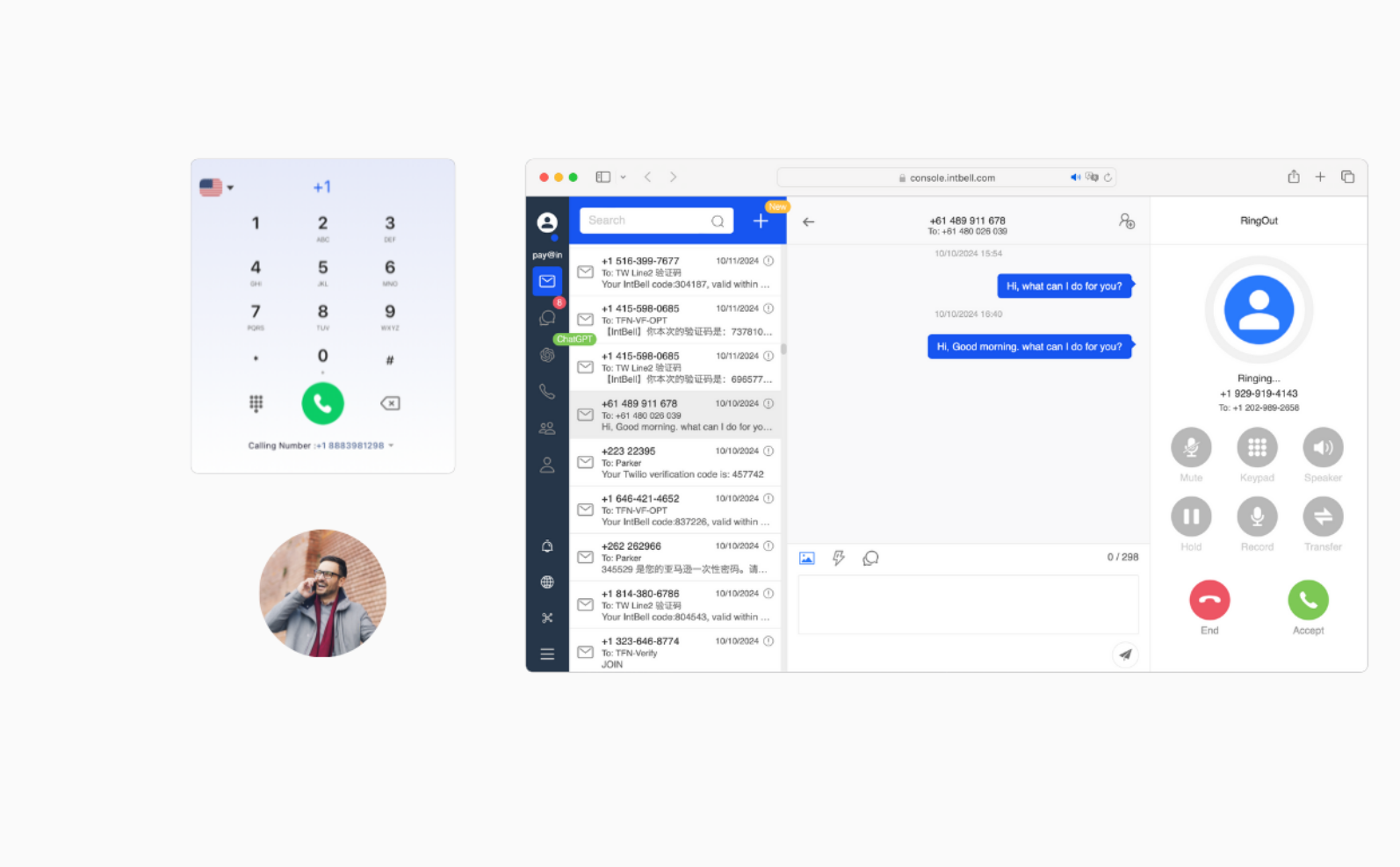
In the tide of globalized commerce, the “first greeting” for enterprises to reach customers is crucial. When your potential customers are scattered across the world, a toll-free phone number with the local country code delivers far more value than imagined. International toll-free numbers are professional tools that help businesses eliminate geographical barriers and build localized trust. What exactly are they? And what changes can they bring to overseas-bound enterprises? This article provides a comprehensive analysis.
I. Nature and Functions: What Exactly Is It?
A Toll-Free Number is a special type of phone number that allows customers to make calls free of charge, with all call costs borne by the enterprise. It is a core tool for businesses to establish low-cost, high-efficiency communication with customers.
- Technical Nature: It does not rely on physical telephone lines but transmits voice and data over the internet. You can think of it as a cloud-based “phone number” identifier, enabling you to make and receive calls, send and receive text messages via mobile apps, computer software, or web browsers.
- Cost-Bearing Model
When customers dial a Toll-Free Number (e.g., numbers starting with 1-800 or 1-888 in the United States), they do not need to pay for long-distance or local calls—all charges are covered by the enterprise. This design significantly lowers the threshold for customer inquiries, making it particularly suitable for multinational companies to engage potential customers worldwide. - Expanded Core Functions
- Interactive Voice Response (IVR): Customers select service types via keypad inputs, such as “Press 1 for product inquiries, Press 2 for order tracking,” to improve self-service efficiency.
- Call Recording: Records call content for employee training and dispute resolution, and can also be used to analyze high-frequency issues and optimize service processes.
- Multi-Device Access: Team members can answer calls via multiple terminals including mobile apps and computer softphones, supporting remote work and flexible collaboration.

II. Core Value and Application Scenarios
1. Business Value
- Building a Professional Image: Over 90% of enterprises in European and American markets use Toll-Free Numbers, which customers recognize as a symbol of “legitimacy and credibility.” For example, a toll-free hotline displaying a local U.S. number (+1) can increase the initial call answer rate by over 40%.
- A Powerful Tool for Market Expansion: Through virtual local toll-free numbers (e.g., +44 for the UK, +65 for Singapore), enterprises can expand into global markets without setting up physical offices, achieving asset-light globalization.
- Privacy Protection and Work-Life Separation: Eliminates the need to disclose personal mobile numbers, preventing information leakage and spam calls, and clearly separating work and personal communications.
2. Typical Application Scenarios
- Customer Service: After-sales support, technical guidance, return and exchange processing, etc. For instance, e-commerce platforms use toll-free hotlines to quickly resolve customer issues and reduce negative review rates.
- Marketing and Sales: Embedding toll-free numbers in advertising campaigns, combined with strategies like “discounts for call-in inquiries,” to boost conversion rates. According to Verizon data, adding a toll-free number to order forms can significantly increase sales revenue.
- Crisis Management: During emergencies (e.g., product recalls), a unified toll-free hotline centralizes inquiry handling and prevents information chaos.

III. Differences from Other Types of Numbers
1. Versus Virtual Local Numbers
- Free-Call Feature: Virtual local numbers only display local attribution (e.g., +44 for London) but require customers to pay for calls; Toll-Free Numbers are completely free for callers.
- Function Complexity: Toll-Free Numbers can integrate enterprise-grade functions such as IVR and call recording, while consumer-grade virtual numbers offer only basic features.
2. Versus Domestic 400/800 Numbers in China
- Coverage Scope: Domestic 400/800 numbers are limited to mainland China and require cost-sharing between callers and enterprises; Toll-Free Numbers support global access with full costs borne by the enterprise.
- Technical Architecture: Toll-Free Numbers are built on global IP networks, enabling seamless integration with CRM systems and cloud call centers to achieve closed-loop data management.
IV. Usage Notes
- Number Allocation Rules: Toll-Free Numbers are uniformly managed by institutions such as the U.S. Federal Communications Commission (FCC) and allocated on a first-come, first-served basis through “Responsible Organizations” (e.g., Ooma, AT&T). Resources for popular prefixes (e.g., 800) are scarce, so enterprises can prioritize emerging prefixes like 833 and 844.
- Number Portability: When enterprises switch service providers, Toll-Free Numbers can be ported to new platforms to avoid customer attrition.
- Data Privacy: Call recordings must comply with international regulations such as GDPR to ensure customer information security.

V. Recommendations for Enterprises: How to Choose a Reliable Service Provider?
Faced with numerous options, following these criteria will help you select the best partner. Taking IntBell as an example, we explain the key attributes of a high-quality service provider:
Alignment of Core Functions with Business Needs
- Key Evaluation Criteria: Does it offer numbers for your target countries? Does it support essential features such as two-way SMS (for receiving verification codes) and call recording (for risk control and training)?
- IntBell’s Practice: Provides numbers for multiple countries worldwide, integrating one-stop business functions including HD calls, two-way SMS, automatic call recording, and intelligent call routing—no need to switch between multiple tools.
Call Quality and Connection Stability
- Key Evaluation Criteria: Does it have dedicated line network optimization? Is complex configuration required for use in mainland China?
- IntBell’s Practice: No need for users to configure VPNs manually. Leverages optimized global network nodes to deliver stable, clear call quality, ensuring professional business communications.
Cost Transparency and Cost-Effectiveness
- Key Evaluation Criteria: Is the pricing structure clear? Are there any hidden fees?
- IntBell’s Practice: Adopts a transparent monthly subscription + pay-as-you-go pricing model with no hidden charges.
Management Convenience and Integration Capability
- Key Evaluation Criteria: Does it provide a user-friendly web backend or app management interface? Does it support team collaboration?
- IntBell’s Practice: Offers a unified multi-device management platform with support for configuring call forwarding, IVR, and other features—ideal for small and medium-sized team collaboration.